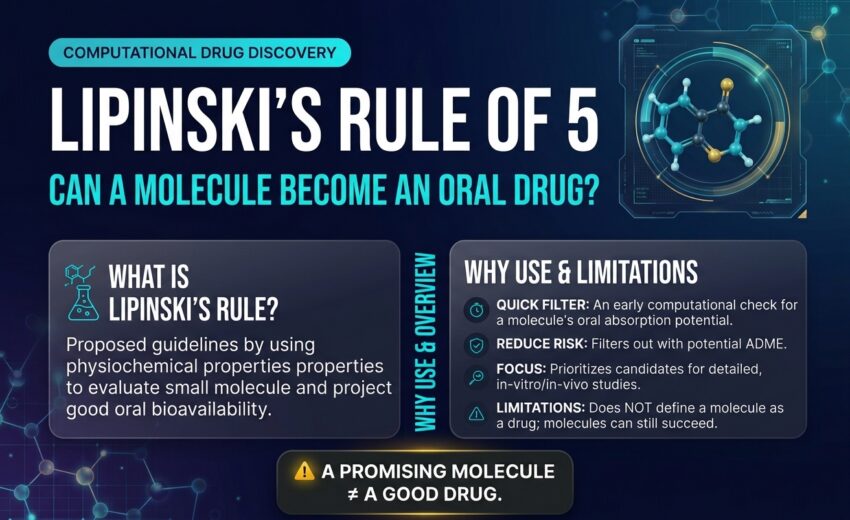
A promising molecule is not necessarily a good drug.
Before investing significant time and resources in drug development, researchers need to ask:
Can this molecule be absorbed?
Can it reach its target?
Can it behave like an orally active drug?
One of the most widely used early filters in drug discovery is Lipinski’s Rule of Five (Ro5).
🔬 WHAT is Lipinski’s Rule of Five?
Proposed by Christopher Lipinski and colleagues, the Rule of Five is a set of drug-likeness guidelines used to evaluate whether a small molecule has physicochemical properties compatible with good oral bioavailability.
The classical rules are:
🔹 Molecular weight ≤ 500 Da
🔹 LogP ≤ 5
🔹 Hydrogen bond donors ≤ 5
🔹 Hydrogen bond acceptors ≤ 10
A compound that violates more than one of these rules is generally considered more likely to have poor oral absorption or permeability.
❓ WHY is it important?
Drug discovery involves evaluating thousands—even millions—of molecules.
Testing every compound experimentally is expensive and time-consuming.
Lipinski’s Rule of Five provides an early computational filter to identify compounds with potentially unfavorable physicochemical properties.
It helps researchers prioritize molecules before moving toward more resource-intensive experiments.
⚙️ HOW is it used in Computational Drug Discovery?
A typical workflow can look like:
Compound Library → Drug-Likeness Screening → ADME Prediction → Molecular Docking → MD Simulation → Experimental Validation
For example, computational tools can estimate:
🧪 Molecular weight
🧪 LogP
🧪 H-bond donors/acceptors
🧪 Topological polar surface area
🧪 GI absorption
🧪 Lipinski violations
Tools such as SwissADME can rapidly evaluate these properties for a large number of candidate molecules.
⚠️ But there is an important limitation
Lipinski’s Rule of Five does NOT tell us whether a molecule is a drug.
A compound can violate one or more rules and still become a successful drug.
🔗 Want to go deeper into Computational Drug Discovery?
Follow. Connect. Learn. Discover. 🧬
–Md. Anisul Islam | Synapse Scholar–