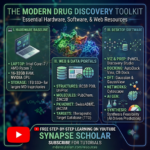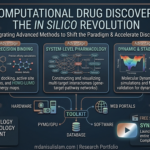
Translating a small chemical molecule into a viable therapeutic traditionally takes over a decade and billions of dollars in computational and experimental validation. Today, the integration of computational biology, molecular docking, network pharmacology, and quantum mechanics is shifting this paradigm—drastically shortening early-stage discovery timelines and lowering research overhead.
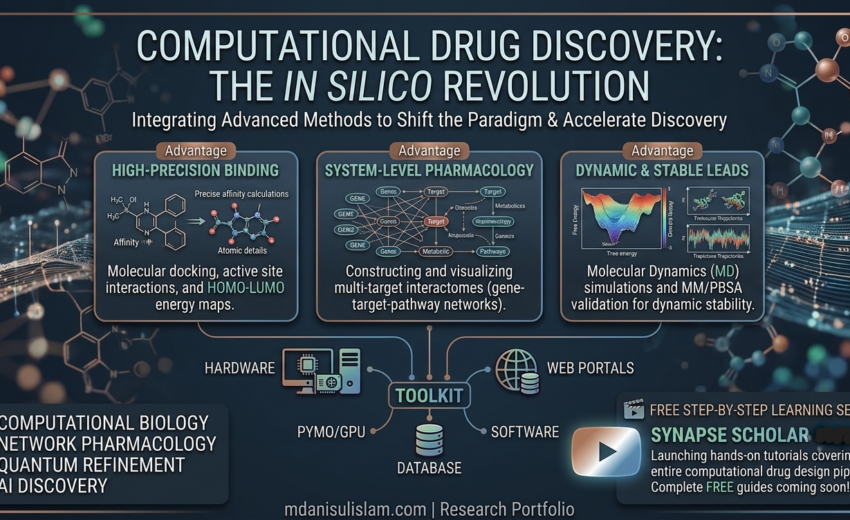
Whether you are an academic researcher, computational chemist, or biotech enthusiast, leveraging modern in silico frameworks offers three strategic advantages over traditional pipelines:
1. High-Precision Target Mapping & Binding Affinity
Molecular docking enables us to predict structural binding modes, active site interactions, and affinity energies at the atomic level before committing resources to wet-lab experiments. Selecting high-resolution protein crystal structures (ideally $< 2.0\text{ \AA}$) and validating grid box coordinates against co-crystallized ligands reduces false positives during virtual screening.
2. Transitioning from “One Target” to System-Level Pharmacology
Traditional drug design focused heavily on the single-target model. Modern network pharmacology allows us to construct and visualize multi-target biological interaction networks (gene-target-pathway interactomes). This offers a holistic understanding of complex polypharmacological mechanisms, neurodegenerative conditions, and metabolic pathway modulations.
3. Quantum-Level Refinement & Structural Mechanics
While molecular docking provides a static snapshot of binding interactions, real biological environments are dynamic. Incorporating Density Functional Theory (DFT) allows researchers to calculate frontier molecular orbital energies ($\text{HOMO-LUMO}$ gaps) and Molecular Electrostatic Potential ($\text{MEP}$) maps to evaluate reactivity. Furthermore, molecular dynamics ($\text{MD}$) simulations validate binding stability and free energy calculations over time.
Free Step-by-Step Learning Series
Setting up software parameters, configuring grid boxes, and running quantum mechanical optimizations can present a steep learning curve. To assist students, young researchers, and biotech professionals, I am launching a free step-by-step video series covering the entire computational drug design pipeline hands-on.
YouTube Tutorials: Synapse Scholar Channel
Research Portfolio & Resources: mdanisulislam.com
What computational tools or web servers do you rely on most in your current research workflow? Drop your thoughts or questions in the comments below!